Planking without a drawing
The frames go up first. The lines office comes later. In the Bodrum ↗ yards, the drawing has always followed the finished boat — not the other way around.
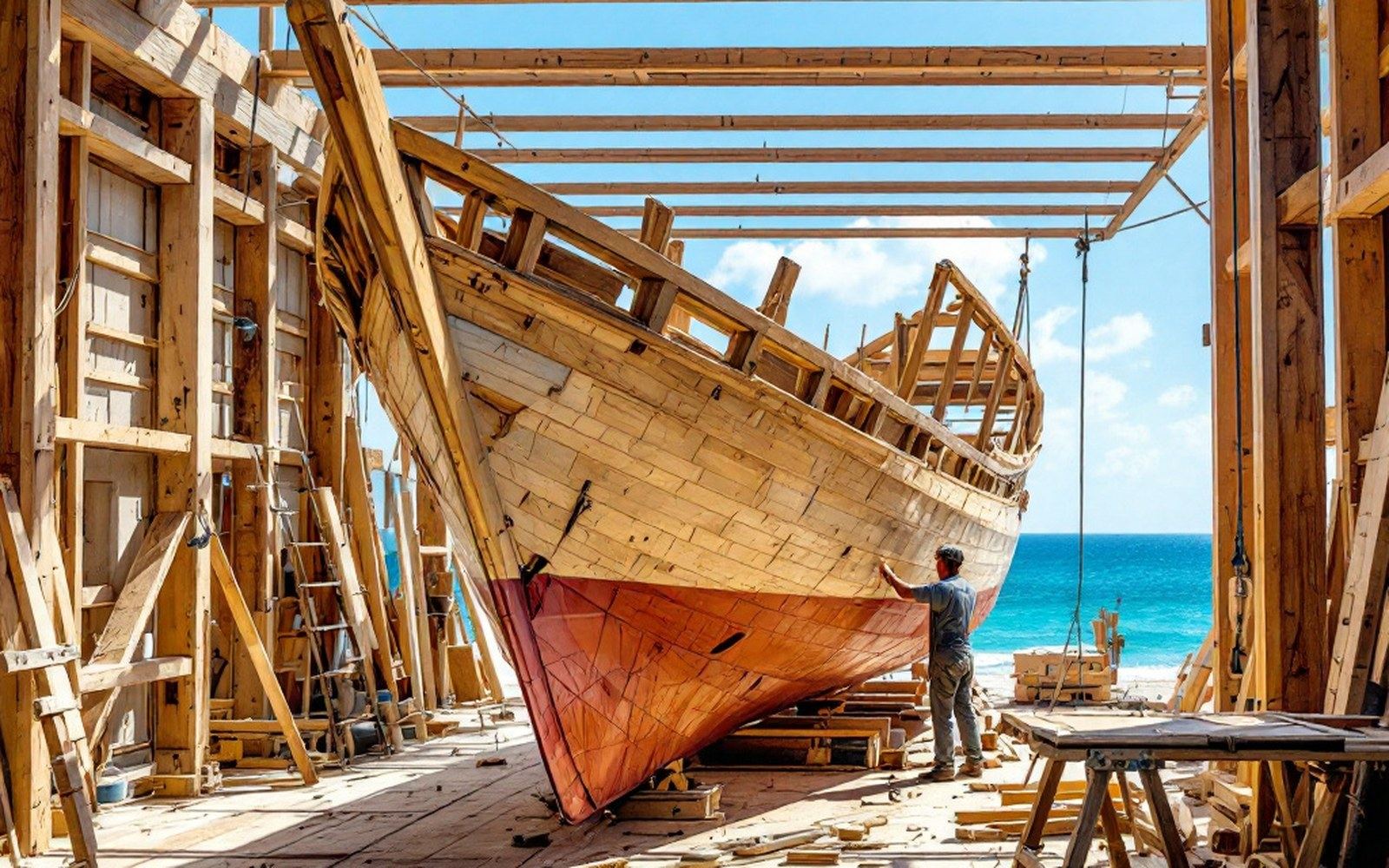
The knowledge in the hands
A traditional gulet — the broad-beamed, ketch-rigged wooden cruiser that defines what these yards actually build — begins not with a draughting table but with a conversation between a master builder and a client: roughly how many people, roughly what budget, roughly how many metres. From that conversation the master builder, the kalfa, carries the essential geometry in his head. He works from a small set of wooden battens, a few templates shaped for stem and transom, and a rule of thumb for the bilge curve that may have been passed down through three generations of the same family in the same yard.
The frames — sawn from iroko, larch or occasionally local oak — are set up on the keel without reference to a drawn body plan. The kalfa judges fairness by sighting along the row of frames the way a carpenter sights along a door to check for twist. If a frame looks wrong, it is adjusted or replaced. The plank, when it goes on, will tell the builder whether the form is fair: a plank that wants to spring off the frame mid-run is a frame that is not where it should be. The material itself provides the feedback that a drawing would otherwise give.
This is not improvisation. It is a tradition of embodied technical knowledge — what scholars of craft history would call tacit knowledge, learning that does not survive transcription into documents because it lives in the gesture, the glance and the adjusted batten. European shipwright traditions operated similarly until the late seventeenth century, when the systematic use of scale drawings became standard in naval construction; Mediterranean boatbuilding workshops preserved oral and manual transmission far longer, partly because their clients did not require it otherwise, and partly because the boats kept coming out right.
Where the drawing enters
Turkish maritime registry does require documentation. A vessel must be measured, its dimensions recorded, and a set of plans lodged before it can be officially registered and entered into commercial service. What the Bodrum yards have historically produced is not a design drawing — a document that precedes and governs construction — but a measured drawing, taken off the completed hull after the planking is on and the hull has been lifted clear of its building blocks.
The process is called, in naval architecture, lines-taking or hull fairing: the surveyor or architect measures a series of offsets from a baseline, locating points on the hull surface at regular stations, and from those measurements constructs the three conventional views — body plan, sheer plan, half-breadth plan — that constitute a lines drawing. The result is formally identical to a design drawing. It carries the same information. It simply records what exists rather than prescribing what should exist, and it arrives at the registry office after the boat is already floating.
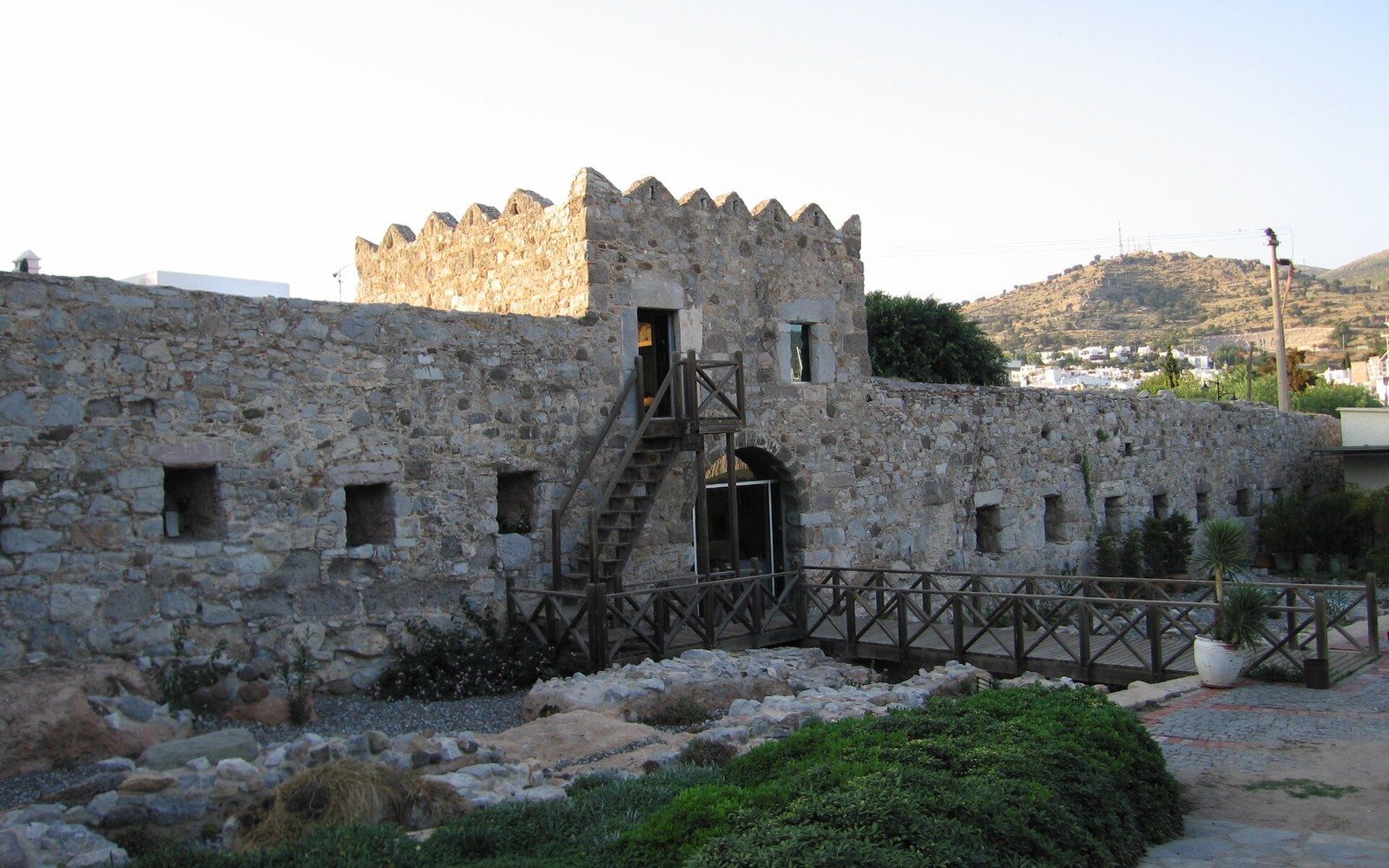
Ağanlar Boatyard, one of the yards that survived Bodrum's long pivot from working waterfront to tourist marina, has built boats on exactly this basis: a client brief, a master builder's knowledge, an agreed length, and the registry survey at the end. The paperwork closes the loop. Whether this qualifies as an industry without drawings, or an industry that produces its drawings at an unusual moment in the sequence, is partly a matter of definition — and largely a matter of which office you are standing in.
What this means for the boat
The practical consequences are not trivial. A hull designed on paper can be optimised in advance: the naval architect can calculate displacement, waterline length, wetted surface and stability from the lines before a single frame is cut. Builders who work from tradition and eye cannot run those calculations ahead of time. They rely instead on accumulated precedent — every gulet that came out of that yard is a data point for the next one — and on the conservatism that tradition enforces. Because no one is inventing the form from scratch each time, the deviation from what worked before is small.
The result is a family of hulls that are recognisably similar across builders and decades: the characteristic full bow, the broad flat stern, the high freeboard amidships that gives the interior its saloon volume. Variation exists, but it is variation within a type. The timber and its fastenings are also conservative — materials that are familiar and forgive minor inconsistency better than composites would. Wood is tolerant of small errors in a way that a fibreglass layup is not.
In practice, the measured-drawing route has been accepted as satisfying that requirement, provided the resulting documentation meets the technical standard.
What this approach does not readily produce is a radical departure from the type. If a client wants a hull with genuinely different performance characteristics — a finer entry, a longer waterline, a deeper keel — a yard working from tradition and eye will find it harder to guarantee the outcome than one working from a full design package. The knowledge in the hands is powerful precisely because it is specific: it knows this boat, in this size range, built this way.
After the measuring
Turkish maritime regulations, administered through the Ministry of Transport and Infrastructure's Directorate General of Maritime Affairs, specify the documentation required for commercial passenger vessels — the category into which most charter gulets fall. The requirement is for plans, not for plans produced at any particular stage. In practice, the measured-drawing route has been accepted as satisfying that requirement, provided the resulting documentation meets the technical standard.
The International Maritime Organization's conventions on intact stability require that stability be demonstrated for any vessel carrying passengers. A measured drawing, once it exists, can be the input for a stability calculation just as a design drawing can. The calculation does not care whether the lines were drawn before or after the keel was laid; it cares whether the numbers are correct. A surveyor performs the inclining experiment — ballast weights moved across the deck, the resulting angle of heel recorded — and the result, combined with the lines, produces the stability booklet that goes aboard. This too comes after the boat exists. The sequence is different from a conventional building project. The regulatory destination is the same.
That gap between sequence and destination is where the Bodrum yards have operated for generations. The craft knowledge came first, the documentation followed, and the boats that emerged from the process have been sailing the coast between Göcek and Kaş long enough that the approach has proved itself empirically, in the water, on passages that test a hull far more honestly than any drawing office review.