The meltemi, and why you leave at six
The Aegean's summer northerly runs on a daily cycle. Understanding it is not seamanship — it's arithmetic.
What the wind actually does
The meltemi is not a storm system and not a squall. It is a large-scale pressure gradient wind that sets in across the Aegean each summer, driven by the thermal low that develops over the Anatolian interior as the land heats through June, July and August. The high that sits more or less permanently over the Balkans and the northern Aegean during those months feeds air south and southeast into that low, and the result is a wind that blows from the north or northwest for days at a stretch, sometimes a week without break, occasionally longer. The European Centre for Medium-Range Weather Forecasts has documented the meltemi as one of the most consistent mesoscale circulation features in the eastern Mediterranean basin.
What matters for anyone moving a boat is the diurnal rhythm layered on top of that background flow. The meltemi typically eases overnight and in the very early morning, then rebuilds as the land heats, reaching its daily peak in the mid-to-late afternoon. By three o'clock on an August day it can be blowing Force 5 in the open Aegean; by five, Force 6 is not unusual in channelled water; by the time a crew is thinking about anchoring and cold beer, the beam sea between exposed headlands is uncomfortable at best and genuinely difficult for smaller vessels. The pattern is reliable enough — and has been known long enough on this coast — to have generated a working rule that every skipper here eventually internalises: leave at six, be anchored by one.
The arithmetic is straightforward. A gulet making six knots covers thirty-six nautical miles in six hours. Most passages between the principal anchorages of the Turkish coast — Göcek and the twelve islands to Kaş, Kaş to Kekova, Kekova around to Fethiye ↗ — can be done in a day's early start if the wind allows, though the longer legs stretch that envelope. Begin at first light, when the sea is still flat and what wind exists is on the nose at fifteen knots or behind you at ten, and the arithmetic works. Sleep in, leave after breakfast, and you are punching into a building chop through the hottest part of the day, arriving tired and slightly abraded.
Where it hits hardest
The meltemi does not distribute itself evenly. Headlands accelerate it; bays suppress it; channels between islands — especially any gap that runs roughly north-south — compress and amplify it. The stretch of coast between Bodrum and Rhodes is effectively a series of such channels, and the crossing between them has an unambiguous character in July and August. Between Kos and Rhodes, where the crossing to the Dodecanese runs across open water with little land to interrupt the fetch, the afternoon sea state can be considerably steeper than the wind speed alone would suggest. A Force 5 northerly over a hundred miles of fetch produces a different sea from a Force 5 inside a sheltered bay.
The coast south of Fethiye has its own exposure logic. Ölüdeniz ↗ sits behind its lagoon, almost theatrically sheltered; the stretch toward Kaş is not. The headlands past Kaş and down toward Kekova face northwest, which is precisely the direction the meltemi arrives from, and the afternoon chop there can stop progress entirely on a gulet that is not designed for windward work. Gulets — broad-beamed, heavy, with relatively modest sail area — are not poor sea boats, but they are not built to beat to windward in a short steep chop. They are built for the early morning run before the wind comes in.
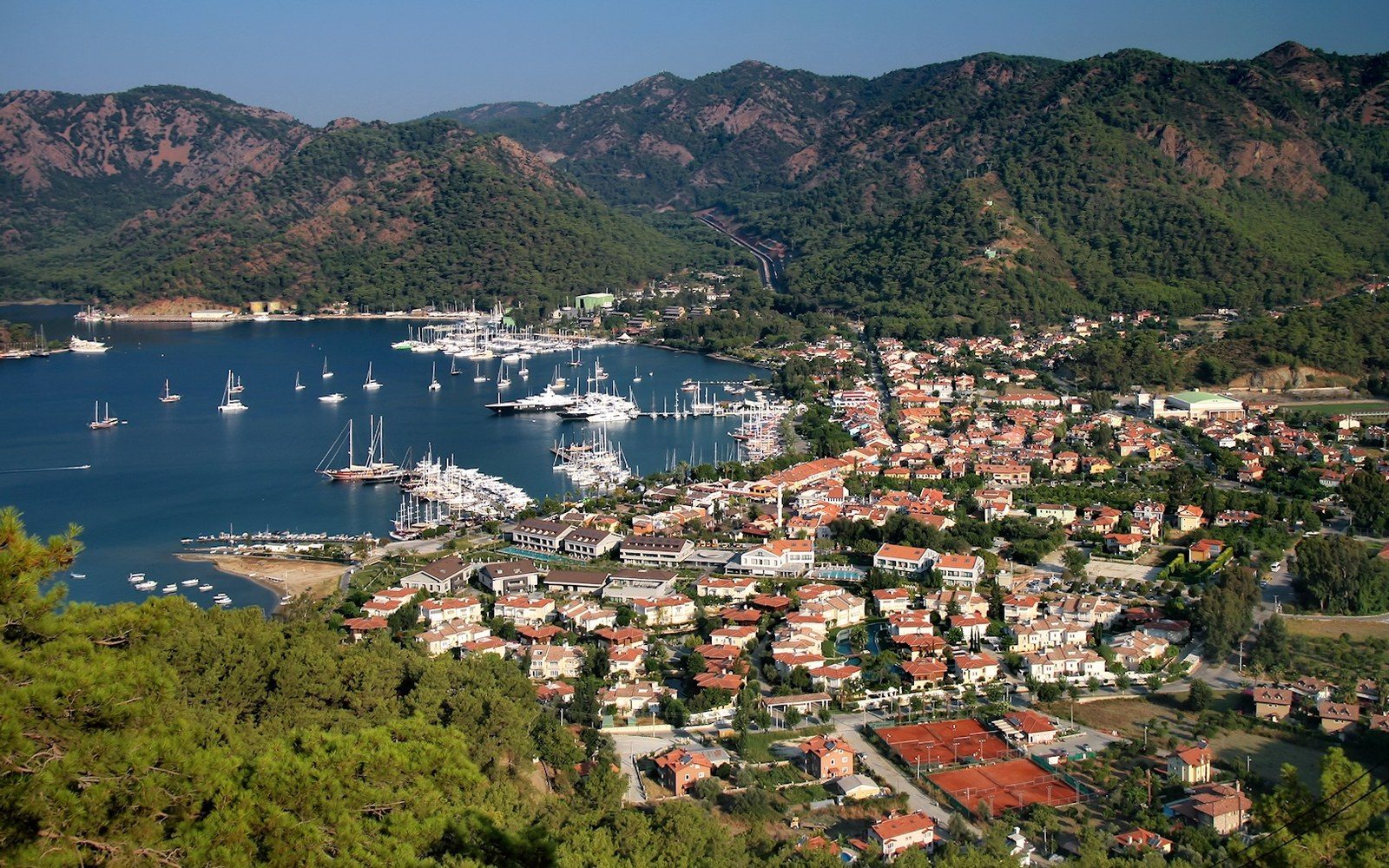
Kekova itself offers a useful case study in microgeography. The channel behind Kekova Island, running between the island and the Lycian shore, is aligned almost east-west and thus sits largely perpendicular to the meltemi. Even on an afternoon that is unpleasant in open water, the Kekova road can be navigable and the anchorages off Simena workable. The wind finds its way in eventually, but the landscape delays it by hours. This is why anchorages earn their reputations over generations — not for beauty alone, but for what they do to the wind.
The cost of not knowing
Planning a passage on the assumption that the meltemi is a weather event — something that might or might not happen — rather than a daily cycle is the mistake that costs time, comfort and occasionally more. A crew that has not slept well, anchors in a roadstead at dusk in twenty-five knots, and makes a passage the following afternoon because morning was spent provisioning in Kaş, accumulates small bad decisions that compound. The provisioning should have happened the evening before. The passage should have left at six.
None of this is exotic knowledge. The Hellenic National Meteorological Service publishes climatological data that makes the seasonal and diurnal structure of Aegean wind systems entirely clear for anyone who looks. The meltemi is well-attested in the literature of the eastern Mediterranean — it appears in classical sources under various names, and the working knowledge of it is embedded in the seasonal rhythms of the fishing communities that pre-date any tourist on the coast. The practice of early departures is not a piece of yachting folklore; it is an adaptation to a meteorological fact that has been stable for centuries.
The meltemi typically eases overnight and in the very early morning, then rebuilds as the land heats, reaching its daily peak in the mid-to-late afternoon.
The practical consequence for anyone planning a week aboard is that the day's structure becomes fixed by the wind rather than by preference. Passages happen in the morning. Afternoons are for anchorages, swimming, shade, and the kind of slow cooking that a cook with three hours and a protected bay can manage. The gulet's design, with its wide stern deck and its deep shade amidships, rewards this rhythm. A week that tries to fight it — that insists on sightseeing in the morning and sailing in the afternoon — spends its energy going the wrong direction.
What it feels like when it comes in
There is a particular quality to the light on a meltemi afternoon that becomes familiar quickly. The air scrubbed clean by the consistent northerly flow is unusually transparent; the water goes from the deep blue of calm to a harder, colder colour; the surface, ten minutes after the afternoon pressure builds, is suddenly covered in small breaking crests running south. At anchor, the boat swings to it and steadies, the passerelle lifts slightly, the awning begins to work at its fittings. At sea, it means something rather different.
The reason you leave at six is not that the sea is dangerous at three. For most passages, on most days, in most summers, it is not. The reason you leave at six is that the morning costs nothing and the afternoon costs something, and on a coast where the arithmetic is this clear, there is no good reason to spend what you do not have to.