What comes aboard, and what stays ashore
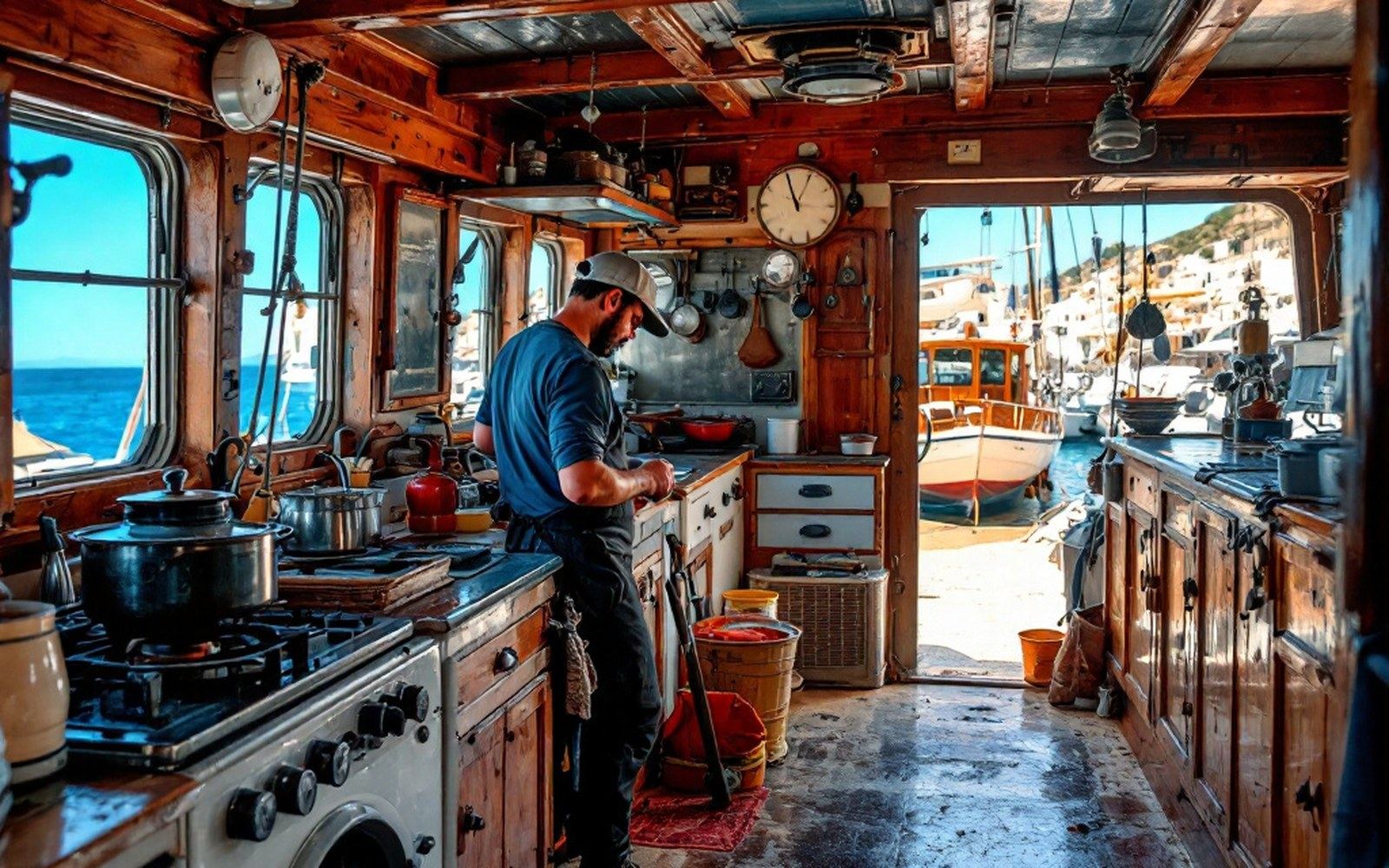
A gulet has a galley, a heads and a saloon built into less than thirty metres — the question is what fits.

Luggage physics and the galley shelf
The instinct is to pack for a week ashore: full cases, options for every weather, shoes for every surface. A gulet's cabins run roughly two metres wide and a metre and a half deep, with storage under the berth and a narrow hanging locker. A rigid suitcase takes most of the floor. Soft bags — duffels rather than rollers — compress into the gaps that rigid cases cannot. This is not a suggestion; it is geometry.
Clothing resolves quickly once the boat is moving. Three or four days into a week's cruise, most people are wearing the same two sets of clothes on rotation and wondering why they brought the rest. Sun protection, a layer for night watches when the meltemi drops the temperature after dark, and one set of something presentable for a restaurant stern-to at a town quay: that is the practical wardrobe. Everything beyond it rides in the bottom of the bag.
Electronics are the modern accumulation: chargers, adaptors, cameras. A well-run gulet has shore-power connectors and USB points in the cabins, but the number of sockets is finite and the competition is real. A single multi-adaptor strip is worth more space than a second jacket.
What the boat already carries matters as much as what passengers bring. The provisioning happens before departure — cooking oil, gas, water, the week's food — and it fills the dedicated spaces a boat was built around. Personal additions work around that structure, not against it.

The single most useful frame for packing is this: imagine everything you bring stacked in the cabin at the same time, because it will be. A hard-shell case ↗ bought for airport convenience becomes an obstacle that cannot be folded flat. A week's sailing rewards minimalism ↗ not as an aesthetic but as an answer to cubic metres.